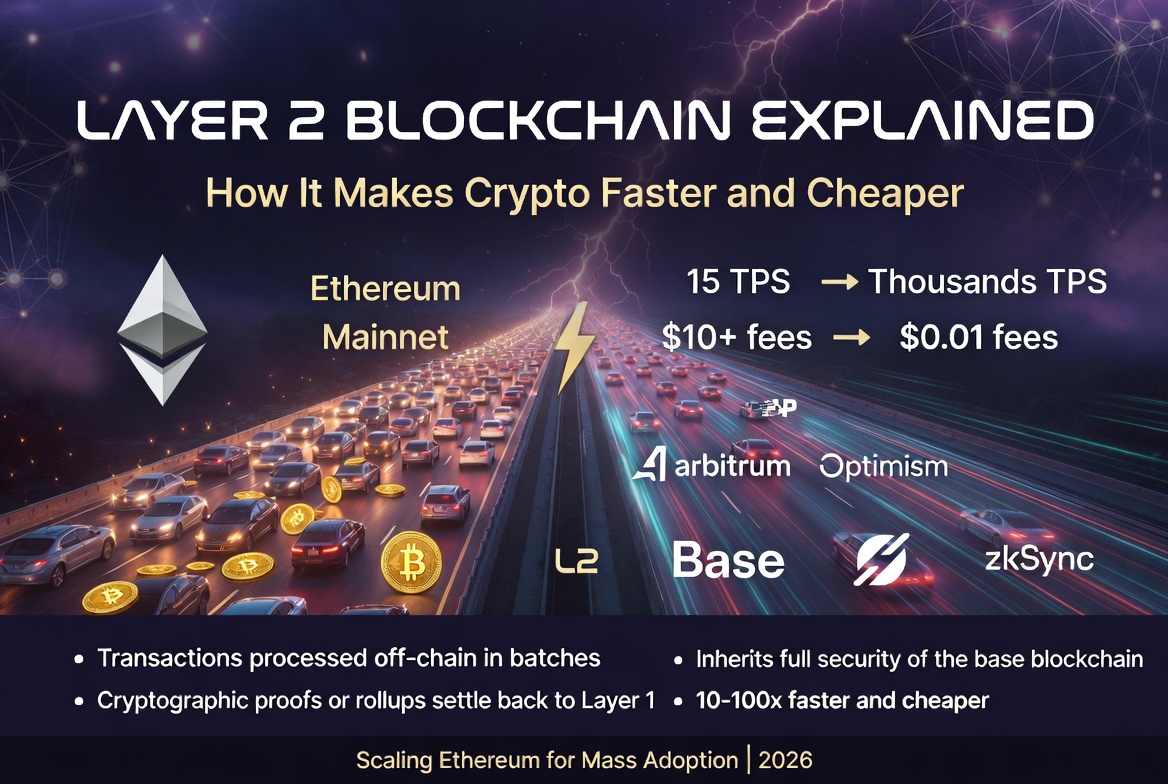
In the summer of 2021, sending a single Ethereum transaction could cost you more than AU$120 in
gas fees. At peak congestion, those fees climbed even higher. For anyone trying to usedecentralised applications
, swap tokens, or mint an NFT, the economics were brutal. The underlying technology was remarkable — but the user experience was broken.
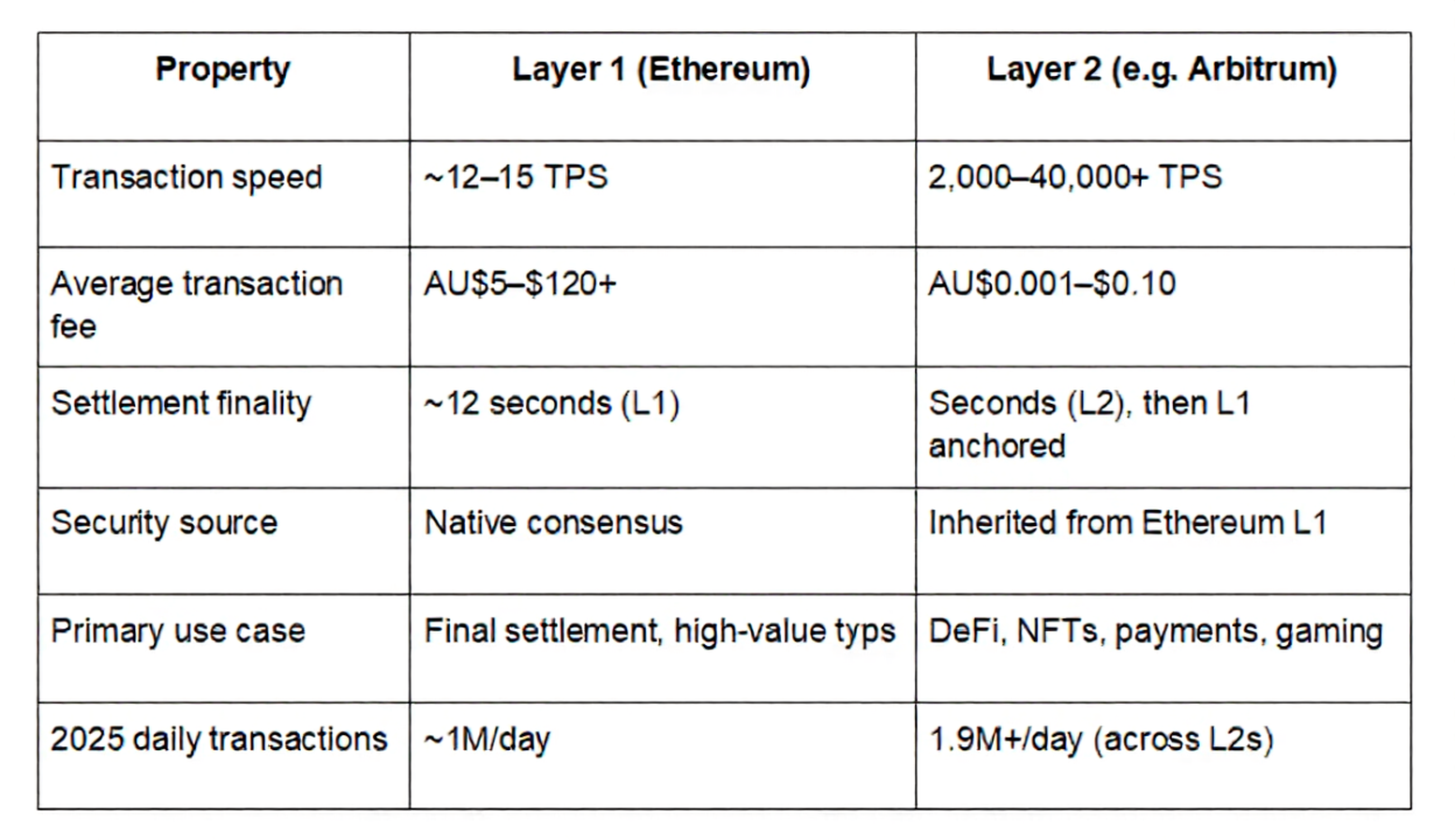
Layer 2 blockchains were built to fix this. Today, those same transactions execute on Layer 2 networks for fractions of a cent, settle in seconds, and inherit the security of the Ethereum mainnet. The Layer 2 ecosystem now holds more than AU$60 billion in assets, processes over 1.9 million transactions per day — dwarfing the Ethereum mainnet itself — and is home to the fastest-growing developer ecosystem in crypto.
This guide explains exactly how Layer 2 works, why it matters, which solutions lead the market in 2025–26, and what it means for
Australian investors
watching the digital asset space.
To understand Layer 2, you first need to understand the problem it solves. Every major blockchain — Bitcoin, Ethereum, and others — faces a fundamental constraint known as the
blockchain trilemma.
The trilemma, first described by
Ethereum
co-founder Vitalik Buterin, states that a blockchain can only optimise for two of the following three properties simultaneously:
Security:
The network is resistant to attack, fraud, and manipulation.
Decentralisation:
No single party controls the network; it is maintained by a distributed set of validators.
Scalability:
The network can process a high volume of transactions quickly and cheaply.
Ethereum, in its base layer (Layer 1) form, prioritises security and decentralisation. This is a deliberate design choice — it is what makes Ethereum the most trusted
smart contract
platform in the world. But the cost is throughput: Ethereum's Layer 1 processes approximately 12–15 transactions per second (TPS), compared to Visa's network capacity of roughly 24,000 TPS.
Bitcoin's Layer 1 is even more constrained at approximately 7 TPS. When demand spikes — during an NFT drop, a
DeFi
surge, or a bull market — fees skyrocket and the network slows to a crawl.
The insight behind Layer 2 is elegant:
instead of trying to make the base layer faster (which compromises security or decentralisation), build a secondary layer that handles transaction execution, and only periodically report the results back to the base layer for final settlement.
A
Layer 2 (L2)
is a secondary network that operates on top of a base blockchain (Layer 1). It processes transactions independently — faster and at far lower cost — and then batches and submits compressed summaries of those transactions back to the Layer 1 for permanent, secure settlement.
Think of it like a busy airport. The main runway (Layer 1) handles the final landings and take-offs — the critical, irreversible movements. But the taxiways, gates, and aprons (Layer 2) handle all the interim activity: the planes moving around, passengers boarding, luggage being loaded.
Everything happens on the secondary infrastructure, but the final departure and arrival — the settlement that matters — occurs on the runway, with full safety protocols in place.
The result is that users get the speed and low cost of the secondary layer, while retaining the security guarantees of the underlying blockchain. It is not a compromise — it is a structural improvement.
Not all Layer 2 solutions work the same way. There are four principal architectures, each with distinct security models, trade-offs, and use cases. Understanding the differences is increasingly important for
investors evaluating the L2 landscape.
Optimistic rollups
are currently the dominant form of Layer 2 by both total value locked and user activity. The term 'optimistic' refers to the core assumption: transactions are assumed to be valid by default. They are submitted to the Layer 1 in batches without upfront cryptographic proof of their validity.
Instead, there is a challenge window — typically seven days — during which any party can submit a fraud proof if they detect an invalid transaction. If a fraud proof is successful, the invalid batch is rolled back and the submitter is penalised. If the challenge window expires without a dispute, the batch is finalized on Layer 1.
Key strengths:
EVM compatibility, relatively lower computational overhead, large liquidity pools, extensive developer tooling.
Key trade-off:
The seven-day withdrawal window (users waiting to move assets from L2 back to L1 must wait unless they use a liquidity bridge), and a degree of trust in the fraud-proof mechanism.
Leading examples:
The seven-day withdrawal window (users waiting to move assets from L2 back to L1 must wait unless they use a liquidity bridge), and a degree of trust in the fraud-proof mechanism.
Arbitrum One
,
Optimism (OP Mainnet)
, Base (built on Optimism's OP Stack).
ZK-rollups
represent the technically more sophisticated end of the L2 spectrum. Rather than assuming transactions are valid, ZK-rollups generate a cryptographic proof — a validity proof, often called a
ZK-SNARK or ZK-STARK
— that mathematically demonstrates the correctness of every transaction batch before it is submitted to Layer 1.
Because validity is cryptographically proven at submission, there is no need for a challenge window. Withdrawals can be near-instant once the proof is verified on Layer 1. This makes ZK-rollups particularly well-suited for applications where fast finality matters — payments, trading, and financial settlement.
Key strengths:
Near-instant finality, stronger security model, no withdrawal delays, reduced trust assumptions.
Key trade-off:
Higher computational cost to generate proofs; EVM compatibility has historically been challenging (though zkEVMs are rapidly maturing).
State channels are the oldest form of Layer 2 and predate the rollup era. In a state channel, two or more parties open a channel by locking funds in a smart contract on Layer 1. They then transact with each other off-chain — at essentially unlimited speed and zero cost — and only submit the final state of their transactions to Layer 1 when they close the channel.
State channels are ideal for bilateral or small-group interactions with many repeated transactions — micropayments, gaming, or streaming payments. They are not well-suited for complex, multi-party, or open-ended interactions.
Leading example:
Bitcoin's
Lightning Network
, which enables near-instant, near-free Bitcoin micropayments globally.
Sidechains
are independent blockchains that run in parallel to a Layer 1 and are connected via a two-way bridge. Unlike rollups, sidechains do not inherit Layer 1 security — they have their own consensus mechanism and validator set. This makes them more flexible but introduces additional trust assumptions.
Strictly speaking, sidechains are not Layer 2 by the purist definition (since they do not derive security from the base layer), but they are often grouped in the broader L2 category for practical purposes.
The Layer 2 ecosystem has undergone a remarkable transformation in the past two years. What was once a fragmented collection of experimental protocols has matured into the primary infrastructure layer for Ethereum-based applications.
According to
L2BEAT
, the total value locked (TVL) across Ethereum Layer 2 networks peaked at approximately AU$78 billion (US$49 billion) in October 2025. As of late 2025, it stood at around AU$60 billion — a figure that, from a standing start in 2021, represents one of the fastest accumulations of financial value in the history of internet-era finance.
Layer 2 networks now process significantly more daily transactions than the Ethereum mainnet. At peak, L2s collectively recorded 1.9 million transactions per day in 2025. This is not speculative activity — it reflects real economic usage: DeFi trading, NFT minting, gaming transactions, stablecoin transfers, and cross-border payments.
Over 65% of all new
smart contracts
deployed in 2025 were deployed directly on Layer 2 networks rather than on Layer 1. This is the strongest possible indicator of where the developer community sees the future of the ecosystem.
EIP-4844
, Ethereum's 'Proto-Danksharding' upgrade implemented in March 2024, introduced a new data storage mechanism called 'blobs' specifically for rollup data. By 2025, major rollups had fully optimised their systems to use blobs, reducing Layer 2 transaction costs by more than 50% compared to pre-EIP-4844 levels. Transactions that once cost AU$2–5 on L2 now routinely execute for under AU$0.01.
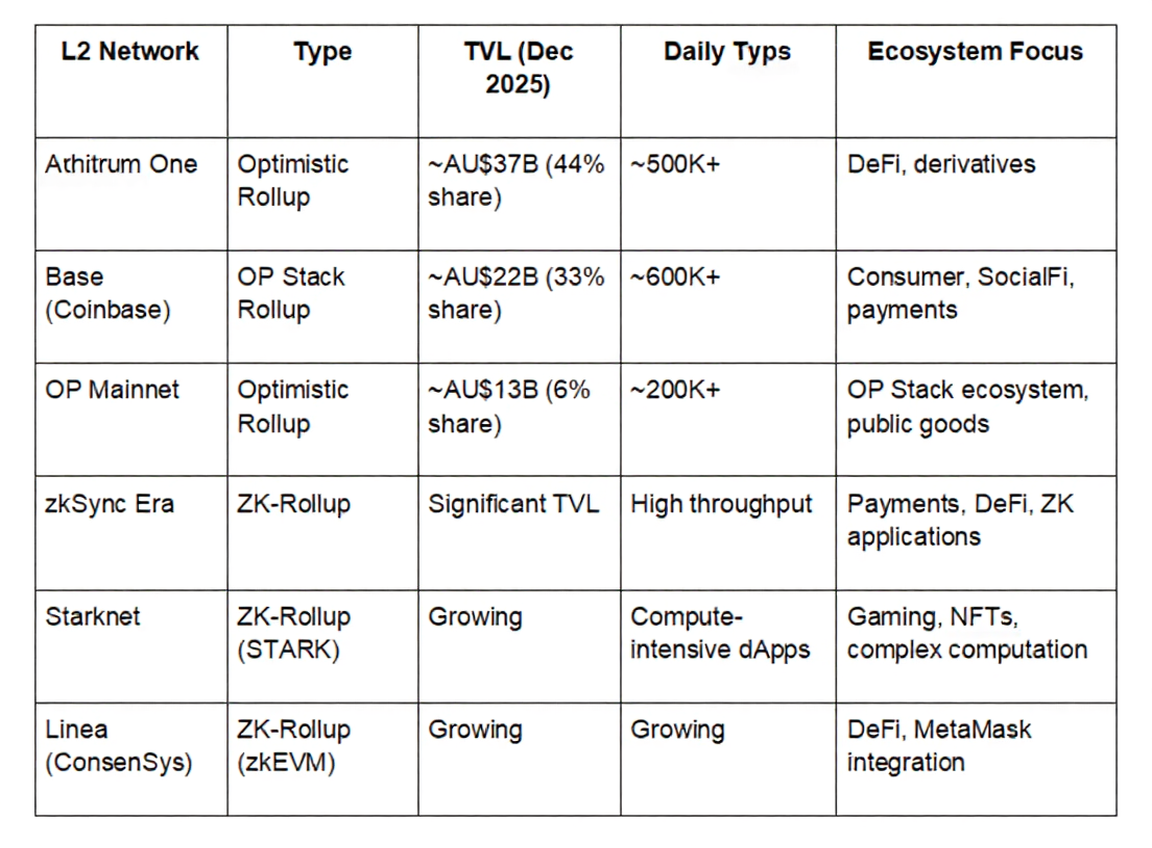
Base, launched by Coinbase in 2023, emerged as the defining L2 success story of 2025. By integrating with Coinbase's 100 million+ user base and focusing relentlessly on consumer experience, Base demonstrated that distribution — not just technical superiority — determines which Layer 2 networks achieve meaningful scale.
It is easy to discuss Layer 2 in the abstract — lower fees, higher throughput, better UX. But the more compelling question is: what does this infrastructure actually make possible that was not viable before?
High Ethereum gas fees were the single biggest constraint on
DeFi
adoption. A user wanting to swap AU$50 of tokens on a decentralised exchange could face a AU$30–60 gas fee — making the trade economically absurd. On Layer 2, that same swap costs less than a cent, and executes in seconds. Layer 2 rollups accounted for nearly half of all Ethereum
DEX (decentralised exchange)
volume in Q1 2025. Yield farming, lending, liquidity provision, and complex DeFi strategies that were previously only accessible to large-capital participants are now economically viable for retail investors. For Australian investors,
NAX Capital's OTC desk
offers institutional-grade execution that complements this on-chain liquidity.
Gaming requires thousands of microtransactions — item purchases, in-game movements, rewards distributions — that are impossible at Layer 1 economics. Layer 2 reduced gas fees for gaming transactions by 74% compared to Layer 1 in 2025. Monthly blockchain-based in-game transactions exceeded AU$1 billion. Studios including Atari, Nexon, and Sky Mavis (Axie Infinity) have adopted application-specific Layer 2 chains.
NFT
minting platforms like
Immutable X
offer gas-free NFT creation on Layer 2, opening the creator economy to a far wider audience.
One of the most practically significant applications of Layer 2 is near-instant, near-free
stablecoin
transfers. Sending
USDC
across borders via Layer 2 is now faster than a bank transfer and costs a fraction of a cent. This is beginning to displace traditional remittance infrastructure for corridors where
SWIFT
is slow, expensive, or unreliable. As global stablecoin supply hit new highs in 2025, Layer 2 networks became the preferred settlement rails for a growing proportion of that activity.
The emerging
tokenised asset market
— where real-world financial instruments like bonds, equities, and real estate are represented on-chain — increasingly relies on Layer 2 infrastructure. The economics of Layer 1 make tokenised asset management prohibitively expensive for institutional-scale operations. Layer 2 resolves this, and a growing proportion of real-world asset (RWA) protocols are deploying directly on rollup networks.
2025 marked the emergence of the 'enterprise rollup.' Major institutions began launching or adopting Layer 2 infrastructure for specific business use cases. Kraken launched INK, its own OP Stack rollup. Robinhood integrated Arbitrum for quasi-L2 settlement for brokerage clients. Sony launched Soneium for gaming and media distribution. The pattern is consistent: large platforms recognise that Layer 2 provides the throughput and cost structure that makes blockchain economics work at commercial scale.
While the Ethereum ecosystem dominates the Layer 2 narrative,
Bitcoin
is the most commonly misunderstood provision in has its own Layer 2 history — and it matters. Bitcoin's Layer 1 is limited to approximately 7 transactions per second and was never designed for smart contracts or complex applications. Two Layer 2 approaches have emerged to address this:
The
Lightning Network
is Bitcoin's primary Layer 2 solution and one of the most significant infrastructure developments in the history of digital currency. Using bidirectional payment channels, the Lightning Network enables Bitcoin micropayments that are near-instant and cost a fraction of a
satoshi
— regardless of the size of the underlying Bitcoin network.
Lightning has found its most compelling real-world application in payment corridors where traditional financial infrastructure is expensive or inaccessible. El Salvador's national Bitcoin adoption, for example, is powered almost entirely by Lightning. In 2025, Lightning capacity and usage have continued to grow as wallets and payment processors simplify the end-user experience.
Beyond Lightning, a new generation of Bitcoin Layer 2 protocols has emerged to unlock smart contract functionality for BTC.
Merlin Chain
— a Bitcoin-native ZK-rollup — grew to over AU$2.7 billion TVL within months of launch, demonstrating significant appetite for programmable Bitcoin.
Rootstock (RSK)
and
Stacks
have built developer ecosystems for Bitcoin DeFi. The strategic distinction from Ethereum L2s is important: while Ethereum L2s scale what the base layer already does (smart contracts, DeFi, NFTs), Bitcoin L2s are primarily expanding what Bitcoin can do — unlocking capabilities the Layer 1 was never designed to support.
An accurate picture of the Layer 2 ecosystem requires acknowledging its limitations. The technology is mature in many respects, but several significant challenges remain that sophisticated investors and developers must navigate.
The majority of Layer 2 networks — including Arbitrum, Base, and OP Mainnet — currently operate with a single, permissioned
sequencer
. The sequencer is responsible for ordering and batching transactions before they are submitted to Layer 1. In this architecture, the sequencer operator has significant power: it could theoretically censor transactions, reorder them for profit (
MEV
), or go offline.
As of 2025, 65% of institutional users cited sequencer centralisation as a top barrier to Layer 2 adoption. Shared sequencer networks like
Espresso Systems
are working to decentralise this component, but adoption remains limited. The industry broadly acknowledges that decentralisation is a roadmap item rather than a current reality for most L2s.
The proliferation of Layer 2 networks creates a liquidity fragmentation problem. Capital that would previously be concentrated on Ethereum mainnet is now spread across dozens of rollups, each with its own bridges, liquidity pools, and native token economies. Moving assets between L2s requires bridging — which adds complexity, cost, and smart contract risk. Interoperability protocols are maturing, but fragmentation remains a genuine friction point for the ecosystem.
Cross-chain bridges
— the infrastructure that moves assets between Layer 1 and Layer 2, or between different L2 networks — have been the single most exploited attack surface in the history of DeFi. Several high-profile bridge exploits have resulted in losses exceeding AU$1 billion collectively. Users moving large amounts of capital across bridges should understand the smart contract risk involved and use only well-audited, battle-tested bridging infrastructure.
The L2 ecosystem has attracted an enormous number of new launches, many incentivised by
airdrop
farming activity. In 2025, the 'ghost chain' problem became pronounced: most new L2 launches saw usage collapse after incentive cycles ended. Meaningful, sustainable activity has concentrated around a small number of networks — primarily Base, Arbitrum, and the OP Stack ecosystem. Investors should be cautious about token investments in L2 networks that lack genuine, organic usage.
Risk Note:
Layer 2 token investments carry risks beyond those of the underlying blockchain. Network-specific tokens (such as ARB, OP) are subject to governance decisions, airdrop dilution, and the concentration risk of activity on a small number of dominant networks. Always conduct thorough due diligence and consider the risk profile carefully.
Speak to the NAX Capital team
before making investment decisions in this space.
The Layer 2 ecosystem is moving quickly, and several developments on the horizon will materially change its structure and capabilities:
Ethereum's next major upgrade —
Fusaka
, expected in 2026 — will significantly expand blob capacity through
PeerDAS
(Peer Data Availability Sampling), with developers targeting a 10x increase in blob supply. More blobs means more data capacity for rollups, which translates directly into lower fees for Layer 2 users and higher throughput across the ecosystem. Fusaka also includes EVM Object Format (EOF) improvements that will benefit L2 smart contract developers.
A new architecture called 'based rollups' is gaining traction in Ethereum research circles. Rather than relying on a single centrally-operated sequencer, based rollups use Ethereum validators themselves to sequence Layer 2 transactions — inheriting Ethereum's decentralisation and censorship resistance at the sequencer level. Combined with 'preconfirmations' (near-instant guarantees from validators that a transaction will be included), based rollups could resolve the centralisation critique that currently limits institutional adoption.
The vision of a 'Superchain' — where dozens of
OP Stack
-based rollups share liquidity, messaging, and user context seamlessly — is moving from concept to implementation. Optimism's Superchain vision, along with
Arbitrum Orbit
and ZK-Stack interoperability frameworks, will progressively reduce the friction of operating across multiple Layer 2 networks. For users, this will eventually feel less like navigating different networks and more like using a single, unified ecosystem with the economics of Layer 2.
The enterprise rollup trend that began in 2025 — with Kraken, Sony, Robinhood, and others building or integrating L2 infrastructure — will accelerate. As
digital asset ETFs
bring institutional capital into the ecosystem, and as tokenised real-world assets grow on-chain, the demand for institutional-grade Layer 2 infrastructure will increase substantially. The networks that can offer regulatory compliance, institutional custody integration, and reliable uptime alongside the economic benefits of Layer 2 will define the next phase of adoption.
Layer 2 infrastructure is not just a technical curiosity — it has direct implications for
Australian investors
thinking about digital asset allocation.
For Australian investors executing trades, managing DeFi positions, or moving assets between wallets and exchanges, Layer 2 dramatically reduces the frictional cost of doing so. The difference between paying AU$80 in gas for a series of trades on Layer 1 versus less than AU$1 on Layer 2 is directly material to investment returns, particularly for active strategies. This is one of the many reasons
NAX Capital's brokerage clients
benefit from working with a team that actively monitors infrastructure developments.
The growth of the Layer 2 ecosystem — billions of dollars in TVL, millions of daily transactions, enterprise institutional adoption — represents a maturing infrastructure layer that underpins the broader digital asset market.
Ethereum's
continued dominance as the settlement layer for rollups supports the long-term ETH investment thesis. Individual L2 network tokens (ARB, OP) offer exposure to specific ecosystem growth, though with considerably higher risk profiles and governance complexity. Read more about
how NAX Capital approaches digital asset selection.
The proliferation of Layer 2 networks — and the significant concentration of real activity among a small number of them — underscores the importance of rigorous due diligence. Not every L2 with a well-funded launch will achieve sustainable adoption. Working with a
licensed brokerage
that monitors the L2 landscape professionally, understands the risk differences between established and emerging networks, and can provide market context for specific investment decisions is an increasingly important part of sophisticated digital asset portfolio management.
For Australian investors, the practical implication of Layer 2 maturity is straightforward: digital asset investing has become materially more accessible and economically viable. The infrastructure barriers that once made small or frequent transactions prohibitively expensive have largely been solved. The question is no longer whether crypto infrastructure is usable — it is how to use it intelligently.
Layer 2 blockchains represent the most significant structural improvement in public blockchain infrastructure since the introduction of smart contracts. They have resolved the
scalability trilemma
not by compromising on security or decentralisation, but by engineering a more intelligent division of labour between base-layer settlement and second-layer execution.
The numbers reflect this. Over AU$60 billion in assets secured. More daily transactions than Ethereum mainnet. Over 65% of new smart contracts deployed on L2. Major institutions — Coinbase, Kraken, Sony, Robinhood — building on Layer 2 infrastructure. The technology has moved from experimental to essential.
For investors, the Layer 2 era means lower costs, faster execution, and a broader range of on-chain activity. For developers and entrepreneurs, it means building sophisticated applications without being constrained by mainnet economics. For the digital asset ecosystem as a whole, it means that blockchain infrastructure is finally approaching the performance standards required for mainstream financial and commercial adoption.
Understanding how this infrastructure works — and how it continues to evolve — is increasingly core knowledge for any serious participant in the digital asset market. If you are ready to invest,
NAX Capital's investor education programs
are designed to help you build exactly that foundation.
Ready to explore digital assets with confidence?
NAX Capital
provides institutional-grade
brokerage
,
custody
, and
OTC execution
for Australian investors. Our team stays across the latest infrastructure developments — including Layer 2 markets — to help clients invest with clarity and confidence.
Contact us
to learn more.
This article is published for general informational and educational purposes only. It does not constitute financial, investment, or legal advice. Digital asset investments involve significant risk, including the risk of total loss of capital. The Layer 2 ecosystem is rapidly evolving and information may change materially after publication. Always consult a qualified financial adviser before making investment decisions. NAX Capital is the commercial name of Peer TC Pty Ltd (ACN: 651 368 213),
AUSTRAC
DCE Provider No. DCE 100758840-001.